A robot is reading your resume before any human does. That's not a metaphor.
Applicant Tracking Systems filter out roughly 75% of resumes before a recruiter ever opens a file. Most job seekers are polishing their formatting and wordsmithing their summaries while completely missing the actual gatekeeper.
The good news: AI tools specifically built to beat ATS filters have gotten fast, accurate, and mostly free to try. The bad news: almost everyone uses them wrong.
This article is for job seekers who have sent out 30, 40, maybe 60 applications and heard almost nothing back. Not because they are underqualified. Because their resume is invisible.
How ATS Systems Actually Read Your Resume
ATS platforms are not reading your resume the way a recruiter does. There is no skimming, no intuition, no benefit of the doubt.
The system parses your document into structured data, then scores how well that data matches a set of pre-programmed criteria for the role.
Some systems are basic keyword matchers. Others use semantic analysis that can detect related terms.
But even the sophisticated ones have hard failure points: unusual fonts, text inside graphics, tables with merged cells, and non-standard section headers can all cause a parser to drop chunks of your resume entirely.
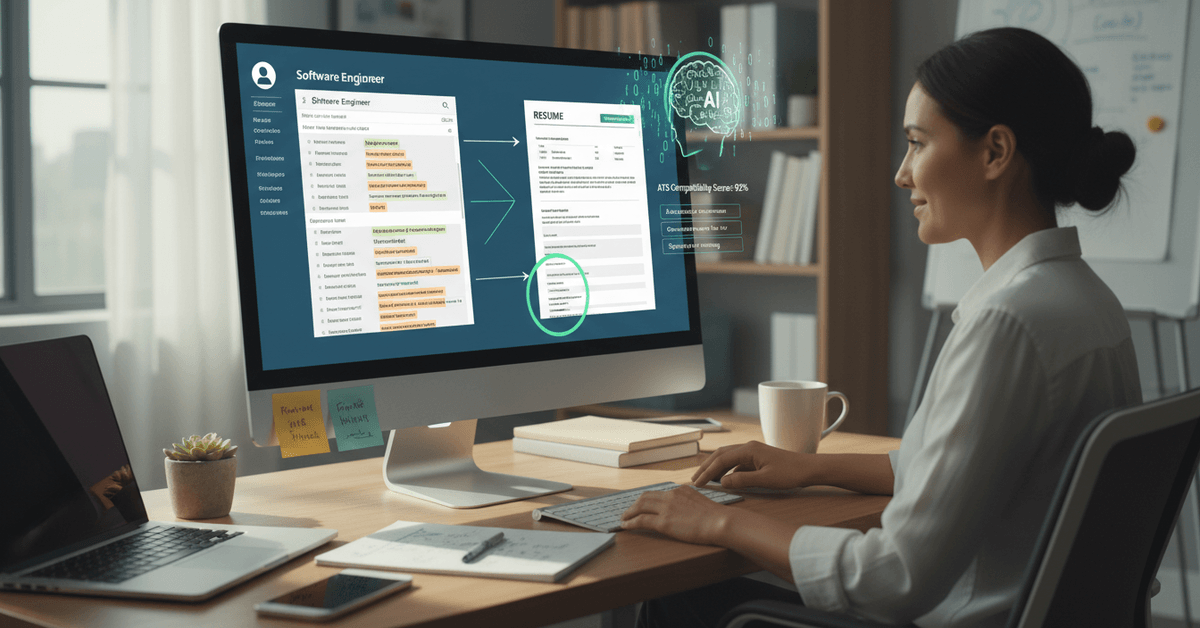
Why clean formatting matters more than you think
A recruiter might notice your beautifully designed two-column layout. The ATS might read it as garbled nonsense or skip the left column completely.
Simple, single-column formats with standard section headers like "Work Experience" and "Education" consistently outperform creative templates in ATS compatibility testing.
Arial, Calibri, and Georgia are among the safest font choices. Anything embedded in a text box or graphic is essentially invisible to most parsers.
The difference between basic and advanced ATS software
Smaller companies often use lightweight systems that do little more than keyword matching. Larger organizations frequently run more advanced platforms such as Workday, Greenhouse, or Lever, which use more advanced parsing and sometimes behavioral scoring.
I think it is worth knowing which category your target company falls into. A startup with 20 employees is probably not running a $50,000-a-year enterprise ATS. A Fortune 500 company almost certainly is. Tailor your approach accordingly.
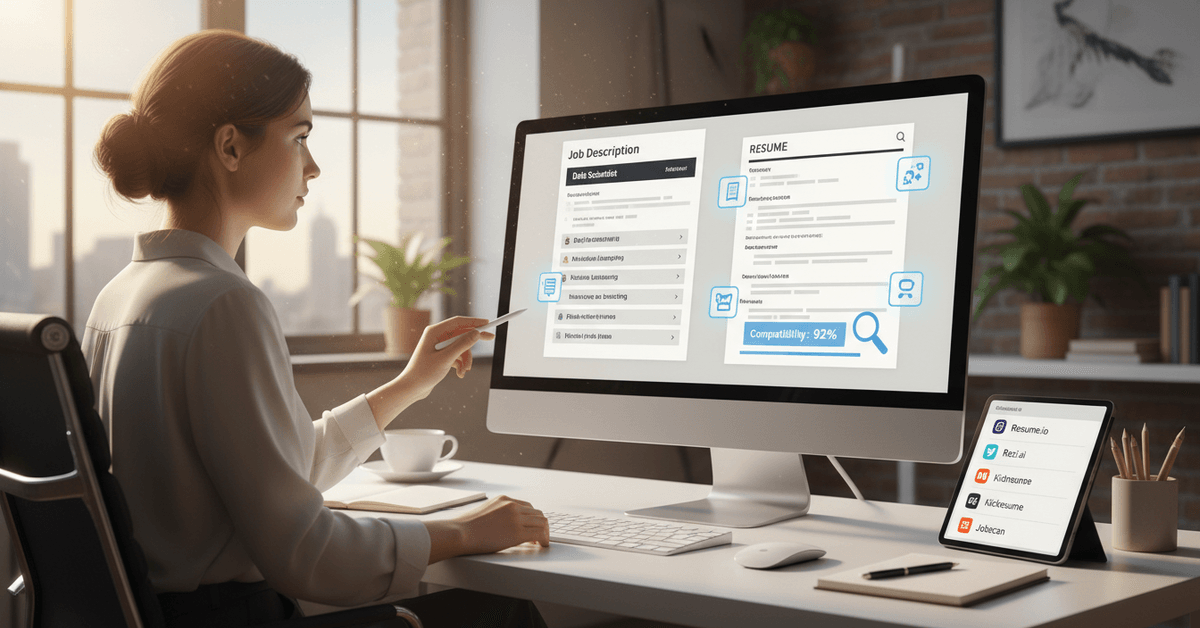
AI Resume Tools That Are Worth Using in 2026
The market for AI-powered resume optimization tools has matured significantly. A few platforms have pulled ahead of the pack in terms of accuracy and ease of use.
| Tool | ATS Keyword Analysis | Free Tier | Best For |
|---|---|---|---|
| Jobscan | Detailed match scoring | Limited scans | Keyword-focused optimization |
| Rezi.ai | Auto-matching to job descriptions | Basic features | Full resume builds |
| Resume.io | Live feedback during editing | Template access | Visual polish with ATS safety |
| Kickresume | Solid optimization + design | Free plan available | Balance of function and aesthetics |
| SkillSyncer | Compatibility scoring | Limited free use | Keyword gap analysis |
Each tool has a distinct strength. Jobscan gives the most granular keyword feedback. Rezi.ai works well if you are building from scratch. Test two before committing to one workflow.
How to actually run the optimization process
The process is simpler than most guides make it sound:
- Copy the full job description into your chosen AI tool alongside your current resume
- Let the system generate a match score and a list of missing or underweighted keywords
- Add missing keywords into relevant sections naturally, not crammed into a skills dump at the bottom
- Run a plain-text export of your resume and check that it reads cleanly without formatting artifacts
- Rescan after every significant edit to track score movement
One thing I was surprised to find: a 5 to 10 point jump in ATS match score often comes from adding two or three specific phrases that appear in the job description but are absent from the resume, not from major rewrites.
The Keyword Strategy Most Guides Get Wrong
I genuinely disagree with the advice to build a single "master resume" and pull from it for each application. That advice treats ATS optimization as a filing task rather than a targeting problem.
Every job posting has a distinct keyword fingerprint. The phrasing a company uses in its listing often reflects the exact terms programmed into its ATS filters. "Project lead" and "project manager" are not interchangeable in this context.
Neither are "customer success" and "client relations." A 2025 analysis by Jobscan found that resumes matching 80% or more of a job description's keywords were significantly more likely to advance past initial screening.
The keyword placement rule that changes everything
Where you put a keyword matters almost as much as whether it appears at all. Keyword placement in job titles, section headers, and the first bullet under each role carries more weight in most ATS scoring models than keyword placement buried in a paragraph at the bottom of the document.
I think the most underused tactic is mirroring the exact job title from the posting in your most recent role header, when it is accurate.
A resume with "Senior Content Strategist" as a listed role title will score higher for a "Senior Content Strategist" posting than one that buries the same phrase in a description.
What AI Still Cannot Do For You
AI resume tools are pattern matchers and scoring engines. They are excellent at flagging what is missing and identifying formatting risks.
They are poor at recognizing the quality of your actual experience, the narrative logic of your career progression, or the human judgment calls that make a resume compelling to a reader.
After you run the AI optimization, read your resume aloud. If it sounds like a list of software features rather than a person's career, the optimization went too far.
Measurable achievements are the bridge between ATS scoring and human interest. "Increased sales by 30% over 12 months" works for both audiences. "Responsible for sales growth" works for neither.
AI tools will flag vague bullets and prompt you to add numbers. Listen to that prompt.
One tool most people skip entirely
Chrome extensions like Jobscan's browser plugin integrate directly into job board pages, running a quick match analysis as you browse listings.
This removes the copy-paste friction and makes it easier to do a quick compatibility check before deciding whether to apply at all. That pre-filter step alone can save significant time across a long job search.
Questions People Ask About AI Resume Optimization
Q: Can ATS systems tell when a resume was AI-generated? Some newer platforms are beginning to flag resumes with unusually high keyword density or formulaic phrasing patterns. The goal is not to generate your resume with AI but to use AI to audit and improve a resume you wrote yourself.
Q: How often should I re-optimize for the same role type? Job descriptions shift over time as companies update their requirements. Running a fresh analysis every four to six weeks keeps your keyword alignment current, especially in fast-moving fields like tech and marketing.
Q: Does a higher ATS score guarantee more interviews? A higher score improves your odds of passing the filter, but it does not guarantee a human will respond positively. A score above 75% is a reasonable target; beyond that, the human quality of your resume matters more than incremental scoring gains.
Q: Are free tiers on these tools worth using? Jobscan's free tier allows a limited number of scans per month, which is enough to optimize for three to five applications. For an active search, a paid subscription at roughly $30 per month tends to pay for itself quickly if it produces even one additional interview opportunity.
Q: Should I submit a plain text version or a formatted PDF? Most modern ATS platforms handle PDFs well, but if an application form has a direct text paste field, use it. Pasting plain text directly bypasses all formatting risk entirely.
Conclusion
Sending the same resume to 50 job postings and expecting different results is a time-consuming way to stay stuck.
Running each application through an AI optimization tool adds maybe 15 minutes to your process and removes one of the most avoidable reasons applications fail.
The tools exist, most have free entry points, and the competitive cost of ignoring them keeps rising in 2026. Start with one job description, one tool, and one honest look at your current match score.