Language learning has a dropout problem. Apps get abandoned after two weeks. Classes feel slow. Textbooks collect dust. Then AI showed up, and suddenly, everyone claims it changes everything.
I think the real shift is more specific than that. AI tutors work best when they stop acting like teachers and start acting like conversation partners who never get tired of you.
The question worth asking in 2026 is not whether AI can help you learn a language. It clearly can. The better question is how to use it in ways that actually stick.
Does AI Language Tutoring Actually Work?
The short answer: yes, but not for the reasons most people think.
The mainstream pitch is that AI gives you personalized lessons and instant feedback. That part is true.
But the bigger unlock is psychological, not pedagogical. When you practice with an AI, there is no embarrassment. No one sighs when you mangle a verb conjugation. No one rushes past your question.

That zero-judgment environment removes one of the biggest hidden blockers in language learning: the fear of looking stupid.
Learners who freeze up in classes or conversation exchanges often open up completely when talking to a chatbot at 11pm on a Tuesday.
What Real Personalization Looks Like in 2026
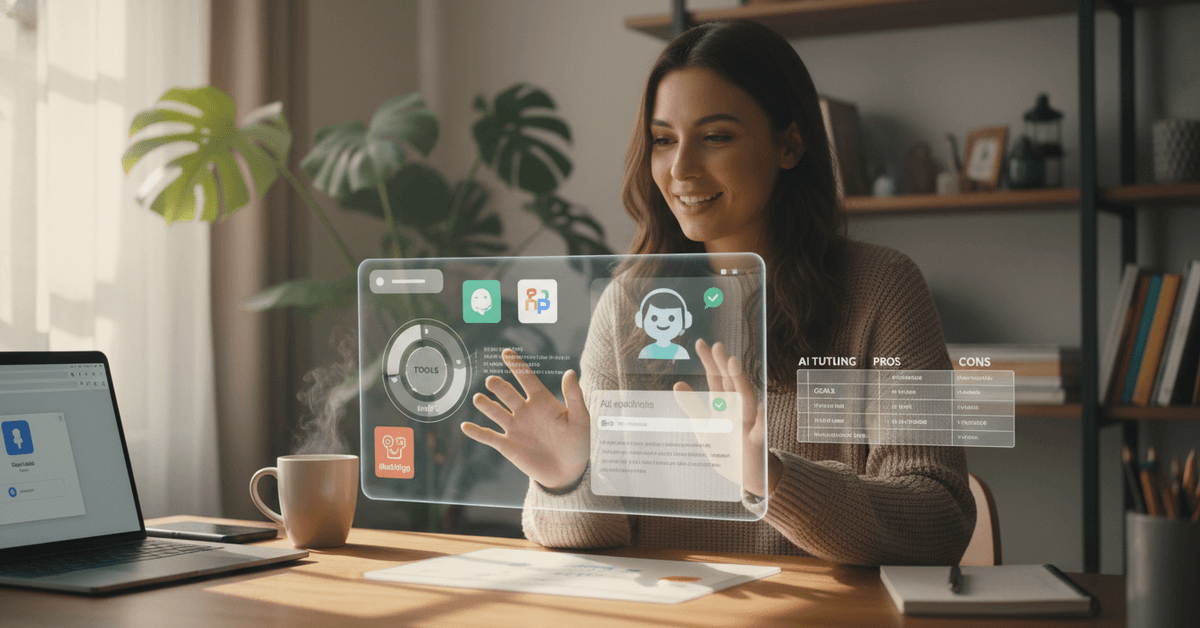
Tools like ChatGPT, Duolingo's AI features, and Memrise have moved well past generic lesson plans.
Duolingo's Explain My Answer function breaks down the grammar logic behind a correction in real time, which beats reading a rule from a textbook and hoping it clicks.
Memrise leans into native-speaker video clips through its Learn with Locals modules, which is one of the more underrated features in the space.
Hearing a native speaker say something casually sounds completely different from a text-to-speech robot, and that gap matters a lot for listening comprehension.
ChatGPT sits in a different category entirely. It handles dozens of languages, holds open-ended conversations, explains idioms and slang, and adjusts its explanations when you ask for simpler versions.
I was skeptical that a general-purpose AI could handle regional dialect nuance until I tested it with colloquial Brazilian Portuguese against European Portuguese. The difference in how it handled those requests was surprisingly sharp.
A Quick Look at the Top Tools
| Tool | Best For | Standout Feature |
|---|---|---|
| ChatGPT | Open conversation and grammar explanation | Handles slang, idioms, dialectal variation |
| Duolingo AI | Structured beginners with daily habits | Explain My Answer function |
| Memrise | Vocabulary and listening comprehension | Native-speaker video clips |
| Google Translate Conversation Mode | On-the-go speaking practice | Instant back-and-forth translation |
| TalkPal AI | Speaking fluency | Real-time speaking sessions |
Duolingo and Memrise suit structured learners. ChatGPT suits curious, self-directed ones. Google Translate Conversation Mode is best when you need something quick and low-friction.
How to Build an AI Tutoring Workflow That Actually Lasts
Most people try one app, lose interest in two weeks, and blame themselves. The problem is almost never discipline. The problem is design.
Step One: Get Specific About Your Goal
"I want to learn Spanish" is not a goal. "I want to hold a 10-minute conversation with my partner's family by August" is a goal. The more specific your target, the easier it is to configure your AI tools around it.
Goal types worth defining upfront:
- Conversational fluency for travel or social situations
- Reading and writing proficiency for work or exams
- Listening comprehension for media consumption
- Formal fluency for professional or academic contexts
Once you know which lane you are in, you stop wasting time on exercises that do not serve you.
Step Two: Stack Passive and Active Practice
A lot of people default to passive learning. They read AI-generated stories, scroll through vocabulary lists, and consume content. That builds recognition. Active production is what builds fluency.
The workflow that holds up over time: 10 to 15 minutes of active conversation or writing daily, supplemented by passive exposure whenever it naturally fits.
Use Chrome extensions like Language Reactor to turn your Netflix queue into a vocabulary session, or ReadLang to make clicking on any word in your browser pull up an instant translation with spaced repetition saving.
That passive layer costs almost no extra effort, and it stacks every day without requiring additional motivation.
Step Three: Use the "Switch Roles" Method
This is the one technique I have not seen covered anywhere else, and I think it is genuinely the most powerful move available to AI language learners.
Try teaching the AI something in your target language. Explain a concept. Tell it a story. Walk it through directions to a made-up location. When you shift from answering questions to generating unprompted language, you expose the gaps you did not know were there.
Most learners can recognize vocabulary in context. Far fewer can produce it on demand without a prompt. Role reversal forces that production, and the AI never makes you feel embarrassed when you get stuck.
The Contrarian Take Nobody Wants to Hear
The most popular advice in AI language learning circles is to use AI as a supplement, never a replacement for real human interaction. Keep it secondary. Use it to prepare for the real conversation.
I genuinely disagree with that framing, and here is why: for adult learners who are dealing with work schedules, social anxiety, limited access to native speakers, or time zones that make finding a language exchange partner genuinely difficult, positioning AI as a secondary tool keeps it permanently underutilized.
My take is that for the first 90 days of learning any language, AI should be the primary practice partner. Not a warm-up. Not a supplement. The main event. You get more reps in, with zero scheduling friction, zero social cost, and immediate correction.
Research from Duolingo's own efficacy studies shows that learners who practice daily, even in short 15-minute bursts, outperform weekly intensive learners on retention metrics.
AI makes that daily practice frictionless in a way human partners simply cannot.
Human interaction matters. But it becomes far more productive once you have 90 days of AI-powered reps behind you.
Pitfalls That Slow Learners Down
AI Misses Cultural Context More Than It Admits
Automated responses handle formal grammar well. Humor, sarcasm, and regional slang are a different story.
If you are learning for business contexts or deeply cultural situations, cross-reference your AI output with a native speaker or a culturally specific resource. The gap between technically correct and naturally fluent is real, and AI still struggles to close it reliably.
Motivation Drift Is the Real Enemy
AI never nags you. That is a feature and a liability. Without external accountability, daily practice can quietly disappear.
Build in friction on the consistency side: streak tracking, a language exchange partner for monthly check-ins, or a public commitment somewhere visible.
Not All Feedback Is Created Equal
AI correction is fast, but it is not always nuanced. On rare verb forms, evolving slang, or highly regional usage, double-check what the AI tells you. It is not infallible.
Cross-referencing with a tool like Grammarly's multilingual features or a dedicated grammar reference keeps you accurate.
Questions People Ask About AI Language Tutoring
Q: Can AI tutors actually help you reach fluency, or just basic conversational skills? Fluency is possible with consistent AI use, but you will need to push the AI into advanced territory intentionally. Ask for debates, abstract discussions, or professional language scenarios. The AI will go there if you lead it.
Q: How much does it cost to use AI tutors for language learning? ChatGPT Plus runs around $20 per month as of 2026, and Duolingo's Super tier is roughly $7 per month. Many learners combine a free tier of one tool with a paid tier of another depending on where their gaps are.
Q: Is it worth paying for premium AI language apps when free versions exist? The free tiers of Duolingo and ChatGPT cover a lot of ground. Premium is worth it specifically for the conversation features, the detailed explanations, and the removal of usage caps that interrupt daily sessions.
Q: How do I stop forgetting vocabulary even when AI drills me on it? Spaced repetition is the mechanism that locks vocabulary in long-term. Tools like Memrise and ReadLang use it automatically. Reviewing old AI chat histories also surfaces forgotten words in context, which is more effective than reviewing a list.
Q: Can I use AI to prepare for official language exams like DELF or JLPT? Yes, with caveats. AI is excellent for grammar drilling, writing practice, and listening comprehension prep. For the formal register and exact scoring rubrics, supplement with official practice materials. AI handles the volume of practice; official materials handle the format.
Conclusion
Every year, millions of people start learning a language and quit within the first month, not from lack of interest but from lack of accessible practice.
The tools available in 2026 make daily, judgment-free, adaptive practice available to anyone with a phone and fifteen minutes.
Building the right workflow takes one afternoon of setup and pays forward every single day. The only thing worth asking now is which language you have been putting off.